
Container workforce camps are engineered to a defined wind resistance rating, and matching that rating to the exposure of the site is what keeps a camp standing through a coastal typhoon season, a desert wind storm, or a highland gale. Wanbang flat-pack container houses are specified for Grade 10 typhoon resistance and Grade 8 seismic intensity, with a Class A fire rating and a service life of 10–15 years. The practical question for a camp buyer is not whether a container unit can take wind — it can — but which rating your specific site demands.
Short answer: Specify the unit's wind resistance rating against the site's real exposure — coastal, desert and highland camps each load the structure differently. For a standard Wanbang flat-pack container house, the published specification is Grade 10 typhoon resistance, Grade 8 seismic intensity, Class A fire rating, and a 10–15 year service life.
Wind load is the pressure that moving air exerts on a building's surfaces. On a container-format building it is resolved in three places:
Workforce camps are usually more wind-exposed than city buildings. They sit on open ground, often with no surrounding structures to break the wind, and on mining, energy and infrastructure sites they may be on an exposed plateau or an elevated bench above the working area. That is why a camp specification has to be set from the site, not from a catalogue default.
Wanbang's standard flat-pack container house is published with the following structural ratings:
| Parameter | Published specification |
|---|---|
| Typhoon resistance | Grade 10 |
| Seismic intensity | Grade 8 |
| Fire rating | Class A (non-combustible), rock wool core |
| Service life | 10–15 years |
| Standard size (L×W×H) | 6,055 × 2,990 × 2,896 mm |
Two practical notes. First, the governing number for a real project is the design wind speed required by the local building code at the site — give your supplier the site location and elevation so the anchoring plan matches the code figure. Second, the same unit can be specified for a range of sites; what changes is the foundation and anchoring detail, not the box itself.
Three site types account for most remote camp projects, and each loads the building differently:
Exposed to typhoon and cyclone seasons plus salt-laden air. Wind resistance and corrosion protection matter together.
Strong winds, wide day-night temperature swings and intense UV radiation. Wind resistance pairs with thermal insulation.
Sustained wind and cold. Units must keep thermal performance while resisting constant load.
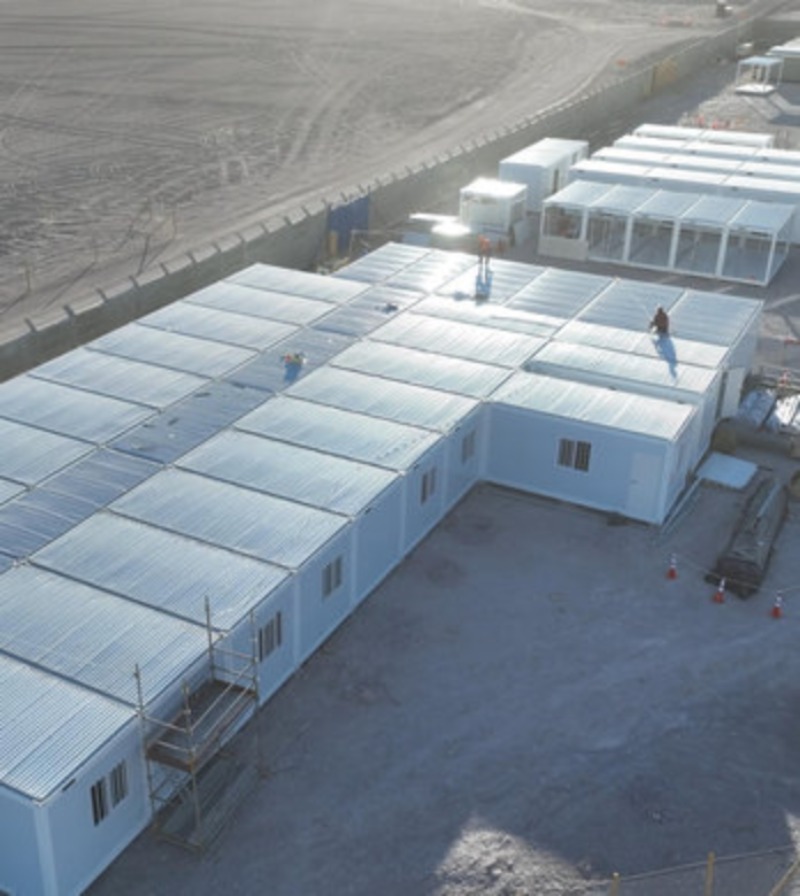
A real example: for the G15 power transmission project in the Atacama Desert, Chile, a camp of 150 integrated housing units was built in a high-altitude South American desert — an environment of extreme temperature swings, intense UV radiation and strong winds. The buildings delivered thermal insulation and wind resistance, and the camp was deployed within 48 hours to meet the project's schedule.
Other camp projects show the same principle applied to different environments: a 360-unit camp for the Hengxing steel plant in Lagos, Nigeria, specified for heat and humidity; more than 500 standard units for the Zamboanga nickel mining camp in the Philippines, with anti-corrosion and anti-rust treatment and no concrete foundation required, cutting construction time by 40%; and a 5,050 m², 1,000-person living compound for the VAN project in Iraq, engineered for high-temperature, sand-laden conditions.
Wind is one axis of a camp's structural specification. Three others are usually reviewed at the same time:
For the layout side of the same decision, see our guide to modular workforce camp buildings for mining and remote projects, or compare the two most common formats in flat-pack vs expandable for site camps.
Wanbang flat-pack container houses are published for Grade 10 typhoon resistance. For a specific coastal site, confirm the required design wind speed against the local code and specify the matching anchoring detail.
It is the unit's published withstand rating against typhoon-force wind. Because exposure varies by terrain and elevation, buyers should confirm the exact design wind speed required for their site with the supplier and their engineer.
Yes — not because the box changes, but because the specification emphasis shifts. Desert and high-altitude sites pair wind resistance with thermal insulation and UV-resistant finishes; coastal sites add corrosion protection.
Yes. Flat-pack and folding units are designed for reuse and relocation: the folding container compresses to roughly one-sixth of its volume for transport, and the flat-pack format can be dismantled and re-erected on a new site.


 IPv6 network supported
Hi! Click one of our members below to chat on
 English
 Français
 Deutsch
 Русский
 Italiano
 Español
 Português
 Türk
Türk Ελληνικά
 Indonesia
 عربي
عربي


