China Modular Building Factory

folding container house

Home

folding container house

  • How Many Container Houses Fit in a 40ft Container? Loading Guide for Flat-Pack, Folding & Expandable Units
    How Many Container Houses Fit in a 40ft Container? Loading Guide for Flat-Pack, Folding & Expandable Units
    Sep 07, 2026
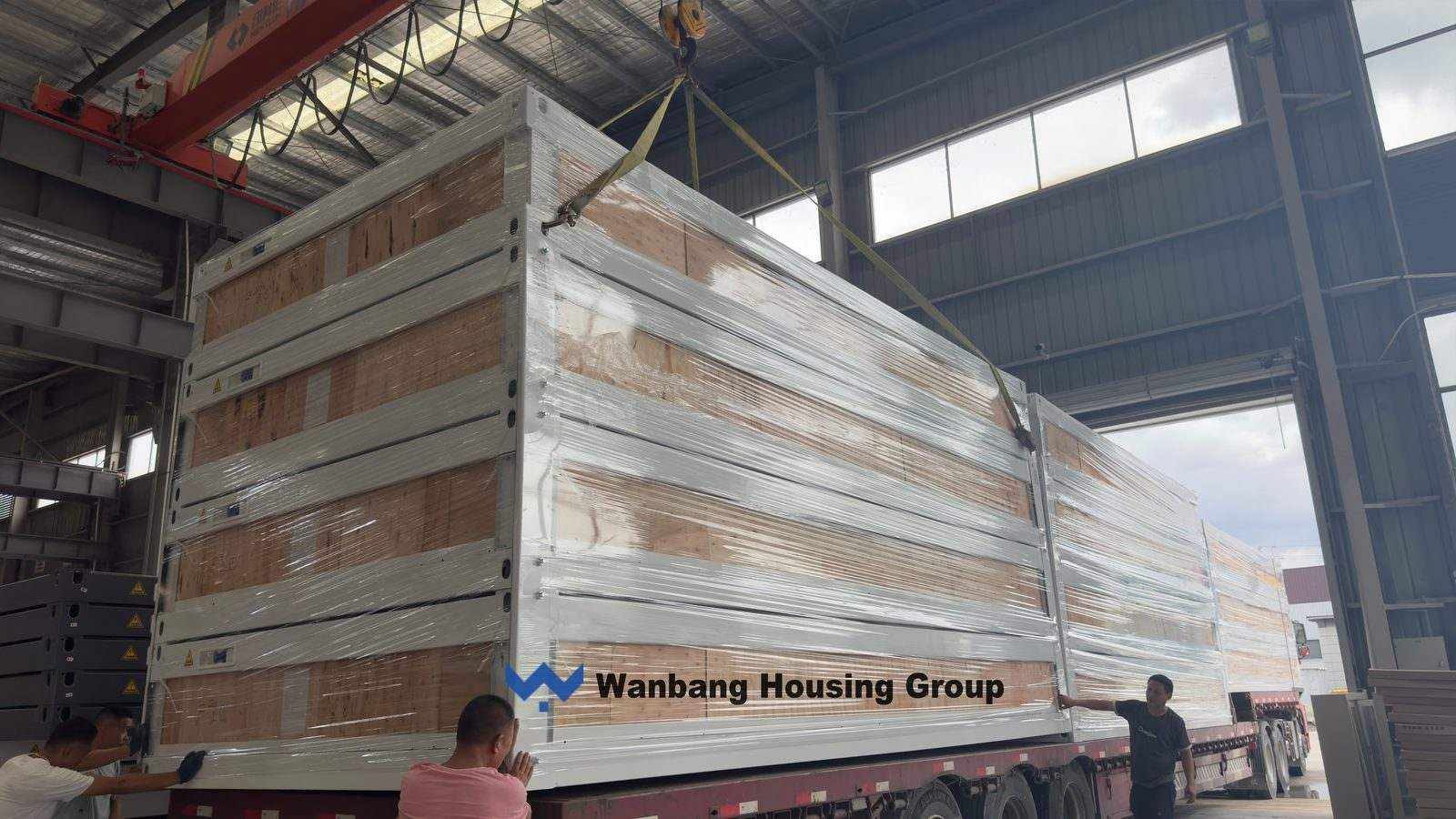
      Direct answer: a standard 40HQ container can load up to 14 quick-assembly flat-pack container houses shipped in knock-down form, or 10 folding container houses with 50 mm wall panels (8 units with 75 mm panels). The double-wing expandable container house ships in its folded state at standard 20 ft dimensions (5900 × 2200 × 2480 mm). Loading density is the biggest single lever on per-unit shipping cost for overseas camp projects — and it is decided by the product's transport design, not by the freight forwarder. Wanbang Holding Group manufactures all three transport formats and has delivered modular buildings to more than 50 countries. This guide explains how each format packs into a 40HQ container, with the real loading figures from Wanbang's product specifications. 1. Quick-Assembly Flat-Pack: 14 Sets per 40HQ The quick-assembly flat-pack container house is designed so that all parts can be shipped in knock-down form — columns, beams, wall panels, and floor panels packed flat and separately. Columns connect to the top and bottom beams with bolts on site. This knock-down design greatly reduces shipping volume, which is what allows one 40HQ container to load up to 14 sets. Specification Quick-Assembly Flat-Pack Container House Standard size (L×W×H) 6055 × 2990 × 2896 mm Frame High-strength galvanized steel Wall panels Color steel rock wool sandwich panels Floor Cement fiber board with PVC flooring Connection Bolt-connected columns to top / bottom beams Transport form All parts shipped knock-down (flat-packed) Loading quantity Up to 14 sets per 40HQ container For a 100-person construction or mining camp, that density means the entire dormitory and office stock can move in a handful of containers instead of dozens — often the difference between a viable project budget and an overblown one. 2. Folding Container House: 10 Units per 40HQ, 15-Minute Setup The folding container house compresses to about one-sixth of its original volume. Folded flat (5900 × 2500 × 400 mm), it stacks inside a 40HQ container; on site it unfolds through hinges, locks, and dedicated connectors. Item Folding Container House Expanded size (L×W×H) 5900 × 2500 × 2470 mm Folded size (L×W×H) 5900 × 2500 × 400 mm Volume reduction Compressed to about 1/6 of original size Loading quantity 10 units per 40HQ (50 mm wall panels) / 8 units (75 mm panels) Setup Only 4 steps, about 15 minutes to build one unit The trade-off is transparent: thicker 75 mm wall panels improve insulation and rigidity, and they reduce the load from 10 to 8 units per container. Projects in hot climates or high-wind regions often accept that cost; short-term rental fleets usually maximize density at 50 mm. 3. Double-Wing Expandable: Ships Folded at 20 ft Size The double-wing expandable container house takes a different approach: it travels as a standard 20 ft unit in its folded state (5900 × 2200 × 2480 mm) and unfolds on site to 5900 × 6300 × 2480 mm — approximately 36 m² of floor area, layoutable as two bedrooms, one kitchen, one living room, and one bathroom. Because it ships as an integrated folded box rather than loose panels, it suits buyers who prioritize on-site speed and a home-style interior over maximum container density. Which Format Should You Ship? Format Units per 40HQ Best for Quick-assembly flat-pack Up to 14 sets (knock-down) Camps needing many standardized offices, dorms, welfare rooms Folding container 10 units (50 mm) / 8 units (75 mm) Rental fleets and projects needing the fastest repeat deployment Double-wing expandable Ships folded at 20 ft size Living quarters needing larger, home-style units (≈36 m²) FAQ How many flat pack containers fit in a 40ft container? Up to 14 sets. The quick-assembly flat-pack container house ships with all parts in knock-down form, which greatly reduces shipping volume and cost. How many folding container houses fit in a 40HQ? 10 units with 50 mm wall panels, or 8 units with 75 mm wall panels. The folding design compresses each unit to about one-sixth of its original volume. How long does it take to install a folding container house? One unit is assembled in only 4 steps, taking about 15 minutes, using hinges, locks, and dedicated connectors — no heavy equipment required. Why does knock-down shipping reduce container house shipping cost? Because loose-packed panels and frames fill a container far more efficiently than pre-assembled boxes. More units per container means lower freight cost per unit — up to 14 flat-pack sets share the freight of a single 40HQ container. Planning an overseas camp and want a loading plan for your route? Contact Wanbang for a container loading calculation.Contact: Jade · Tel: +86 13312807790 · WhatsApp: +966 50 2737 116 · Email: Jade.li@gdwbhouse.com For the full import sequence and what to confirm at each step, see our guide: https://www.gdwbprefabhouse.com/how-to-import-container-houses-from-china-from-inquiry-to-on-site-installation  
    Read More
  • What Is a Folding Container House? Folded Size, 40HQ Loading and 15-Minute Installation Explained
    What Is a Folding Container House? Folded Size, 40HQ Loading and 15-Minute Installation Explained
    Sep 08, 2026
    Direct answer: A folding container house is a factory-built modular unit that collapses to 5900 × 2500 × 400 mm — compressing to roughly one-sixth of its expanded volume — so that 10 units with 50 mm wall panels (or 8 units with 75 mm panels) fit inside one 40HQ shipping container. On site, a unit unfolds in about 15 minutes in four steps, using hinge and latch connections instead of on-site welding. It is the fastest-to-ship option in Wanbang's modular range for camps that need many bedrooms delivered in few containers. Wanbang Holding Group manufactures folding, flat-pack and double-wing expandable container houses in Guangdong, China, and has delivered modular buildings to more than 50 countries across Africa, South America, Southeast Asia, the Middle East and Oceania. This guide explains how the fold-out design works, how many units fit per container, and when a folding unit is the right choice compared with a flat-pack one. 1. How the Fold-Out Design Works A folding container house ships with its roof, floor and folded wall panels pre-assembled into one flat pack. The walls are attached to the base frame through factory-installed hinges and lock latches. When the unit reaches the site, workers unfold the four walls upward and outward, lock the latches, and the structure becomes a rigid, weathertight box — no on-site welding and no craning of individual wall panels. Because the most labour-intensive parts (frame, roof, folded walls) leave the factory as one integrated unit, site work is limited to unfolding and locking. That is why installation time is measured in minutes per unit rather than hours. Item Folding Container House (verified specification) Expanded size (L × W × H) 5900 × 2500 × 2470 mm Folded size (L × W × H) 5900 × 2500 × 400 mm Volume compression Approx. 1/6 of expanded volume Connections Hinges and lock latches (factory-installed) Packing per 40HQ 10 units (50 mm wall panels) / 8 units (75 mm wall panels) Installation 4 steps, approx. 15 minutes per unit 2. How Many Folding Container Houses Fit in a 40HQ Container? The folded height of 400 mm is what makes the packing density possible. Stacked inside a standard 40-foot high-cube container (12.03 × 2.35 × 2.69 m internal), the units nest together with their wall panels protected between frames. 10 units per 40HQ — with 50 mm wall panels. The thinner panels take less stacked height, so one more unit fits into the same container. 8 units per 40HQ — with 75 mm wall panels. The thicker panels improve the feel of the interior envelope, at the cost of one stacking position per container. For procurement teams, this is the key trade-off: panel thickness versus units per container. A 100-bedroom camp shipped with 75 mm panels needs 13 containers instead of 10 — the freight difference is often the deciding factor, and the right answer depends on the climate and standard of the camp you are building. 3. Folding vs Flat-Pack: Which Ships Better? Both are space-saving designs, but they solve different problems. Flat-pack units ship as knocked-down kits — every panel and beam packed separately — while folding units ship as pre-assembled fold-down boxes. The practical differences: Criterion Folding Container House Flat-Pack Container House Units per 40HQ 10 (50 mm panels) / 8 (75 mm panels) 14 (knocked-down kits) Installation per unit 4 steps, approx. 15 minutes Approx. 4 workers × 3 hours (bolting, no welding) Site skill required Unfold and lock latches Assemble panels and bolt frames Best for Fast deployment, repeated relocations, labour-scarce sites Large permanent camps, maximum container density Standard expanded size 5900 × 2500 × 2470 mm 6055 × 2990 × 2896 mm A common pattern on remote projects is to mix both: folding units for dormitories that must open on day one, and flat-pack units for offices, kitchens and wet modules assembled in parallel. Wanbang supplies both lines from the same factory group, so mixed orders ship together. 4. Typical Uses on Remote Projects Folding units earn their keep wherever many bedrooms must open quickly with minimal site labour: Mining and construction camps — dormitory blocks that unfold as the site is still being graded; Labour camps in hot climates — pair the units with the insulation specification your project requires (50 mm or 75 mm panels) before shipping; Relocatable site offices and welfare rooms — fold down, truck to the next site, unfold again; Emergency and relief accommodation — one 40HQ delivers ten ready-to-finish rooms. Wanbang has deployed modular camps for projects including the Indonesia Tsingshan nickel industrial park, the Nigeria Hengxing steel plant camp and the Chile G15 power transmission project — delivered across special geographic conditions in more than 50 countries. Frequently Asked Questions How many foldable container houses fit in a 40ft container? 10 units with 50 mm wall panels, or 8 units with 75 mm wall panels, per 40HQ high-cube container. The folded height of 400 mm — about one-sixth of the expanded volume — is what allows this density. How long does it take to install a folding container house? About 15 minutes per unit in four steps: position the folded pack, unfold the walls, lock the latches, and complete the connections. No on-site welding is required. What is the folded size of a folding container house? 5900 × 2500 × 400 mm (L × W × H). When expanded it becomes 5900 × 2500 × 2470 mm — a usable interior height of about 2.4 m after floor and roof panels. Should I choose 50 mm or 75 mm wall panels? 50 mm panels maximise shipping density (10 per 40HQ); 75 mm panels give a heavier wall build (8 per 40HQ). For hot-climate camps, tell us the project location and insulation requirement, and we will confirm the specification that fits both the climate and your freight budget. Need a camp quote based on folding units? Tell us the number of bedrooms, panel preference and destination port — Wanbang will confirm the packing plan and freight estimate. Contact Wanbang for a factory-direct proposal.Contact: Jade · Tel: +86 13312807790 · WhatsApp: +966 50 2737 116 · Email: Jade.li@gdwbhouse.com Folding vs flat-pack compared side by side, including loading and install times: https://www.gdwbprefabhouse.com/flat-pack-vs-folding-container-house-which-ships-more-units-and-installs-faster  
    Read More

  • Flat-Pack vs Folding Container House: Which Ships More Units and Installs Faster?
    Flat-Pack vs Folding Container House: Which Ships More Units and Installs Faster?
    Sep 09, 2026
    Flat-Pack vs Folding Container House: Which Ships More Units and Installs Faster? Short answer: flat-pack container houses ship more units per container — 14 sets in one 40HQ — while folding container houses install far faster, at about 15 minutes per unit versus roughly 3 hours. If your cost driver is freight, flat-pack wins. If your constraint is site labour or speed, folding wins. Most projects choose based on which of those two pressures is heavier. Both types are factory-built steel-framed modular units shipped from China for workforce camps, site offices and remote accommodation. The difference is in how they travel. A flat-pack unit leaves the factory as loose components — panels, columns, beams and floor boards packed flat and stacked — and is assembled on site. A folding unit leaves the factory as a complete box that collapses to a fraction of its height and is unfolded on site. Side-by-side: the numbers that actually decide the order Item Quick-Assembly Flat-Pack Folding Container House Set-up dimensions 6055 × 2990 × 2896 mm 5900 × 2500 × 2470 mm Usable floor area per unit ≈ 18 m² ≈ 14.8 m² Shipping form Loose components, flat-packed Complete unit folded to 5900 × 2500 × 400 mm Volume when packed Flat stacked panels Compressed to about 1/6 of set-up volume Loading per 40HQ 14 sets 10 sets (50 mm wall panel) / 8 sets (75 mm wall panel) Installation About 4 workers, ~3 hours per unit About 4 steps, ~15 minutes per unit Site equipment No welding, no crane required Unfolding sequence, no welding Why the “folding” one ships fewer units This is the part buyers find counter-intuitive. A folding unit compresses to roughly one sixth of its volume — so it should ship better, right? In practice, what you are shipping is still a whole box: floor, roof, wall panels and frame folded together, 400 mm thick once collapsed. A flat-pack unit, by contrast, is broken down into its individual parts, which stack with almost no wasted air between them. The result: 14 flat-pack sets per 40HQ against 10 folding sets (8 sets if you specify the thicker 75 mm wall panels). On a project that needs 40 or 100 units, that difference is several containers of freight, and freight is often the single largest variable cost in a container house order. Where the folding unit wins: time on site Flat-pack assembly is straightforward — bolted connections between columns and top/bottom beams, with wall and floor panels fixed in sequence — but it is still an assembly job: about four workers and three hours per unit. Folding units reverse that. The unit arrives as a finished box, and the site work is a short unfolding sequence measured in minutes. That matters in three situations: Tight mobilisation windows — a camp that must be habitable this week rather than next month. Expensive or scarce site labour — remote mining and power projects where a skilled crew costs far more than a container slot. Repeat relocation — camps that move as the work front moves along a transmission line or haul road. Usable space: flat-pack gives you more per unit Per unit, the flat-pack footprint is larger: roughly 18 m² against roughly 14.8 m² for the folding unit. If you are fitting dorms, a kitchen block or a site office into a fixed number of units, that difference changes how many units you have to buy in the first place — which partly offsets the freight advantage, and is worth doing the arithmetic on before you commit. How to choose in practice Choose flat-pack when Freight cost per unit is your main lever — 14 sets per 40HQ is the best loading figure we can offer. The camp is a fixed, long-term installation. You need the larger per-unit floor area for dorms, offices or kitchen blocks. You want individual components replaceable without scrapping a whole unit. Choose folding when Speed of deployment is the binding constraint. Site labour is expensive, limited, or short-windowed. The camp is expected to be relocated during the project. You prefer a unit that arrives finished and simply opens. Practical tip: send us your headcount, site location and project duration, and we will run both options through the same container-loading calculation. The answer usually becomes obvious once freight and site labour are priced against each other for your specific country. Frequently asked questions Which type is cheaper to ship? Flat-pack, in units per container: 14 sets per 40HQ versus 10 sets (50 mm panels) or 8 sets (75 mm panels) for folding units. On large orders that typically means fewer containers. Which type installs faster? Folding units — roughly 15 minutes per unit through a four-step sequence, compared with about three hours for a four-worker crew assembling a flat-pack unit. Can both types go in the same shipment? Yes. Mixed shipments are common when a project needs fast-deployment units for the first phase and flat-pack units for the permanent camp. Loading plans are calculated per order, because the two types do not stack the same way. Which is better for a long-term fixed camp? Usually flat-pack. It gives more usable area per unit, assembles into a rigid bolted structure, and is designed for a service life measured in years rather than a temporary stopover. Folding units suit shorter or mobile deployments better. Do both types need a crane or welding on site? Flat-pack assembly needs no welding and no crane. Folding units are set down and unfolded. Site requirements still depend on ground conditions and your foundation design, which we confirm per project. If you are comparing the two for an upcoming project, our team can quote both options side by side, including a container-loading plan for your destination port. Request a flat-pack vs folding quotation and loading plan Related reading: What Is a Folding Container House? Folded Size, 40HQ Loading and 15-Minute Installation Explained
    Read More

Get Free Quote

Get Free Quote
Ask Price Now  
Submit

Home

products

whatsApp

contact

Start a Conversation

Hi! Click one of our members below to chat on