
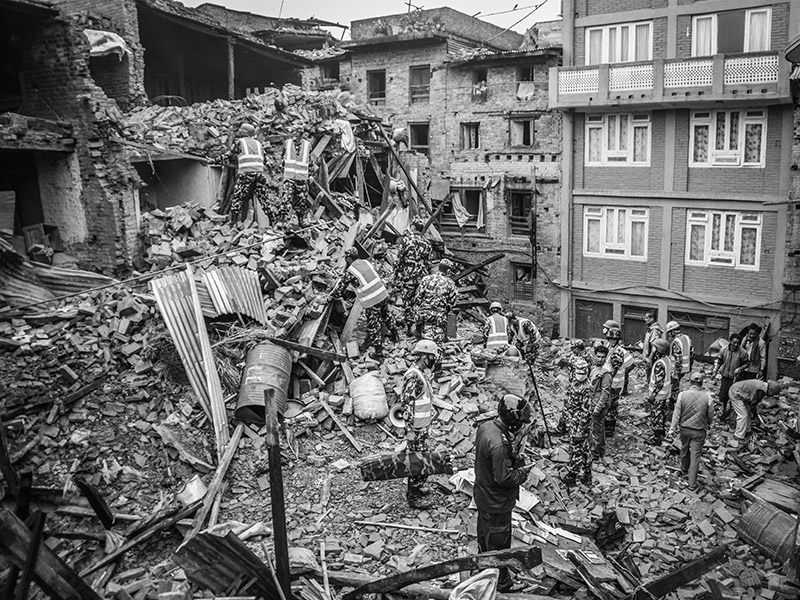
Earthquakes destroy not only buildings, but also the routines and sense of security of daily life. As a manufacturer of container houses and modular buildings, we design products that can help disaster-affected communities move through each stage of recovery. This article looks at how container houses support post-disaster reconstruction — from the first days of emergency shelter to longer-term community rebuilding — and what to consider when planning a modular response.
Post-earthquake needs typically develop in stages: emergency shelter, transitional resettlement, and longer-term rebuilding. The flexibility of container houses makes them a practical option at each stage, because the same modular system can serve different functions as conditions change.
In the first days after an earthquake, speed matters most. Foldable container houses are designed for rapid deployment: units are delivered folded, opened on site with minimal tools, and can be fitted with insulation, lighting and basic power connections to provide shelter while families wait for permanent housing.
Beyond housing, the same units can be configured as medical points, command centers or registration offices, giving relief teams usable space quickly.
Once the emergency phase passes, families need more than a roof — they need classrooms, clinics, offices and places to gather. Modular units can be combined side-by-side and end-to-end to form temporary schools, health posts and community facilities. This helps restore the everyday functions of a community while permanent buildings are planned and funded.
As reconstruction moves forward, modular buildings can be relocated from transitional sites to permanent projects, or re-configured as the community grows. Because the units are re-usable assets, they do not become waste when the immediate need is over.
Effective disaster housing depends on a repeatable, predictable process. A typical modular deployment follows four steps:
Compared with conventional on-site construction, factory-built modular buildings offer practical advantages in disaster settings:
Well-planned modular responses do more than house people. They give local organizations a base to rebuild services, they keep construction work moving through local contractors and suppliers, and they demonstrate that temporary solutions can still be dignified, comfortable and safe.
Because units can be reused, a relief project can grow into a lasting asset — for example, a site office becomes a school annex, or transitional housing becomes staff accommodation for the reconstruction workforce. Foldable and expandable units are particularly well suited to this kind of staged, evolving use.
Planning modular housing for a relief or reconstruction project? Contact us with your site conditions, unit quantity and required functions, and our team will help you plan a solution that fits each stage of recovery.


 IPv6 network supported
Hi! Click one of our members below to chat on
 English
 Français
 Deutsch
 Русский
 Italiano
 Español
 Português
 Türk
Türk Ελληνικά
 Indonesia
 عربي
عربي


