
Modular construction vs traditional construction is one of the first decisions on any camp, site office or multi-unit building project - and the honest answer is that neither method wins on every count. Modular construction is stronger where schedule certainty, unit-to-unit consistency and future relocation matter. Traditional construction is stronger where bespoke design, permanent assets and maximum architectural freedom matter. On cost, the gap is narrower than the percentages quoted in most online comparisons, because the real difference sits in the delivery scope: what the factory supplies, what the site must add, and who carries each risk. This article compares the two methods across time, cost structure, quality and flexibility, and ends with a decision framework plus the checks that keep a modular quote comparable.
For buyers planning workforce accommodation, site facilities or temporary-to-semi-permanent buildings, the comparison comes down to six factors:
| Factor | Modular construction | Traditional construction |
|---|---|---|
| Schedule | Factory production runs in parallel with site preparation | Sequential stages on site, one after another |
| Budget certainty | Concentrated in a factory price plus quantifiable logistics | Absorbs months of site risk: weather, labor, material swings |
| Unit-to-unit consistency | Same drawings, jigs and inspection points for every unit | Depends on site crews, which vary even within one project |
| Design freedom | Constrained by module dimensions and transport rules | Effectively unlimited |
| Relocation and reuse | Units can often be moved and reconfigured between projects | Fixed to the site for its service life |
| Site disruption | Short installation window, fewer trades on site | Long presence of crews, plant and material storage |
The table describes typical patterns for single-storey modular programs, not universal specifications - judge every project on its own drawings, site conditions and delivery scope.
Search for a modular vs traditional construction comparison and you will find confident figures - buildings delivered 30-50% faster, total costs 10-20% lower - usually published by organizations selling one of the two methods. The patterns are directionally true but rarely precise: those percentages were mostly measured on domestic projects with scopes, labor markets and transport distances that look nothing like a cross-border modular order.
For a buyer importing modular buildings from China, five variables move the comparison far more than any industry average:
Use industry percentages as a direction of travel, then let your own quotation set - modular landed total vs traditional local tender - provide the evidence for the decision.
The schedule advantage of modular construction comes from doing two work streams at the same time: while the factory produces the units, the site team prepares foundations and utilities in parallel. Traditional construction is sequential - each stage waits for the previous one, and every stage is exposed to weather, labor availability and material delivery risk.
Production periods are model-specific, not universal. On Wanbang product pages, standard flat-pack office units list production periods of around 10-15 days, while larger expandable models list around 20-25 days; order quantity, customization and the date the order is confirmed all move these figures. Production time is not total delivery time - ocean freight, customs clearance and on-site assembly are additional and depend on the destination. Treat any timeline as model-specific and confirm it against your quotation rather than against an article.
Once units arrive, on-site work is mainly bolting, utility connections and commissioning, following the shop drawings supplied with the order - compressing the on-site presence of workers and plant into a fraction of a conventional build program.
Comparing a single price per square meter hides the real difference. The two methods spend money in different places:
A modular order typically includes these cost blocks: the unit price ex-works, inland and ocean freight, customs and import duties, foundation and site works, crane and installation crew, utility connections and any on-site electrical or plumbing completion the model does not include, and compliance documentation. Most of the spend concentrates in two places - the factory price and logistics - and both are quantifiable before you sign.
Traditional construction spreads spend across months of site activity: extended preliminaries and supervision, weather-related idle time, skilled labor premiums in remote areas, and financing costs over a longer program. Each block carries variance that only shows up as the project progresses.
This is why modular budgets tend to be more predictable even when the headline price is similar: a larger share of the total is fixed at order confirmation. When you collect quotations, keep them comparable - identical specification, delivery scope, transport assumptions and installation responsibility. The checklist in what should be included in a prefab house quotation covers the items that quotes most often leave out.
Modular buildings are manufactured, not improvised. Every unit in an order follows the same drawings, the same jigs and the same inspection points, which makes it practical to deliver one standard across dozens or hundreds of identical units. On a conventional site, quality depends on individual crews and working conditions, and it can vary between stages of the same project.
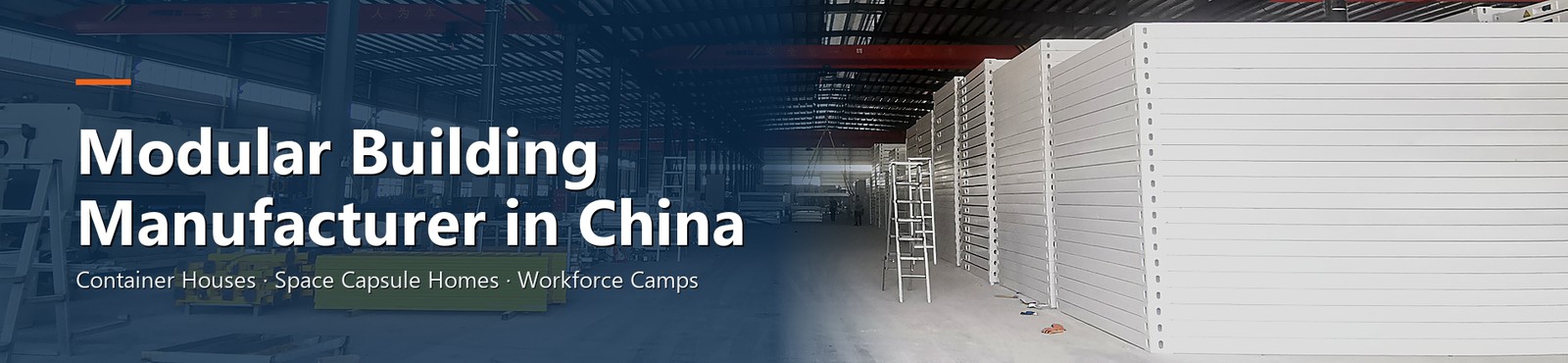
Wanbang Modular produces flat pack container houses, expandable and folding units, capsule houses and steel structure buildings. The company operates five production bases, and its factory area covers about 120,000 square meters. Quality management is certified to ISO 9001, environmental management to ISO 14001 and occupational health and safety to ISO 45001, together with EU CE certification.
Frame specification, panel type and fastening systems follow the wind, snow and seismic requirements of the destination site - confirm them per model and per project rather than assuming they are universal.
A modular building is an asset that can move with the contract. Units can be relocated between sites, reconfigured into different layouts and redeployed on the next project. For mining, energy and construction contractors running a pipeline of projects, that second-life value is a genuine part of the cost case: the same accommodation blocks can serve camp after camp, while a traditional building stays fixed to the site it was built on.
A fair comparison has to state the other side. Traditional construction remains the stronger choice when:
If none of modular construction's advantages apply to your project, traditional construction is not a compromise - it is the right tool for the job.
Put the two methods against your project specifics:
If the framework points toward modular, the next choice is unit type: flat pack vs expandable container houses compares the two formats on shipping density and installation speed.
Is modular construction cheaper than traditional construction?
There is no universal answer. The outcome depends on delivery scope, order quantity, transport distance, foundation requirements and local labor rates. Modular budgets tend to be more predictable because most spend is fixed at the factory price plus quantifiable logistics, while traditional budgets absorb months of site-level variance. Compare landed totals against a local tender before deciding.
How much faster is modular construction?
There is no universal total delivery time. Production periods vary by model and order, and the schedule advantage mainly comes from running factory production in parallel with site preparation. Confirm a model-specific schedule against your quotation.
Are modular buildings as durable as traditional buildings?
Durability follows the specification, not the method. Steel frame dimensions, panel type and fastening systems follow the site's wind, snow and seismic requirements, and long-term performance also rests on the foundation and installation quality. Confirm the specification per model rather than assuming it.
Can a modular building be relocated later?
Often, but not automatically. Whether a unit can be moved depends on the product's structural design, the handling conditions at both sites and the unit's condition after its first service period. Review relocation against the supplier's drawings before a move is planned, not afterwards.
How do I compare a modular quote against a traditional construction quote?
Insist on the same basis: identical floor area and specification, the same delivery scope, the same transport assumptions and the same installation responsibility. Quotes that look cheaper on different scopes are not comparable - the quotation checklist above shows what to line up first.
Comparing modular and traditional for an upcoming project?
Send us your unit quantity, target site and schedule. Our team will prepare a specification-based comparison and a landed-cost quotation, so the decision rests on your project's numbers. Contact Wanbang Modular.
Related reading:


 IPv6 network supported
Hi! Click one of our members below to chat on
 English
 Français
 Deutsch
 Русский
 Italiano
 Español
 Português
 Türk
Türk Ελληνικά
 Indonesia
 عربي
عربي


