
A workforce camp budget has several cost blocks, and the container house price covers only the first. Freight, foundations, site works, utilities and installation sit outside most factory quotes. This breakdown maps who normally owns each line, so your budget does not rest on the unit price alone.
This article is written for procurement teams and EPC buyers comparing supplier quotations. It does not quote prices — those depend on specification, quantity, route and season. What it does give you is the cost structure of a remote camp project, the boundary of a manufacturer's scope, and the questions that expose a quotation's gaps before they become variations.
When buyers compare suppliers on unit price, they are comparing the one line that is easiest to quote and often the smallest variable in the total. A container house leaves a factory gate; it still has to cross an ocean, clear a port, reach a site, sit on a foundation, get lifted into position and connect to power and water. Every step after the factory has its own contractor, its own schedule and its own risk.
The result is the most common budget failure in camp projects: a competitive building quote inside a budget that was never assembled. The fix is not a cheaper unit. It is a complete cost map with an owner against every line.
Most remote workforce camp projects break into six cost blocks. Who owns each block is not fixed: it depends on the contract scope, the destination's local regulations, and how far the supplier's service extends. Some buyers purchase buildings delivered to port, some purchase them installed on site, and some engage a turnkey contractor who bundles several blocks. The split below is the typical default — what a factory building quotation normally covers, and what it normally excludes — but confirm it against your own contract before budgeting.
| Cost block | What it covers | Normally owned by |
|---|---|---|
| 1. Building supply | Dormitory, office, dining, ablution and other modular units, to the agreed specification | Building manufacturer (in quote) |
| 2. Freight and delivery | Ocean shipping, port charges, inland haulage to site, unloading | Buyer or freight forwarder (logistics quote, usually outside factory quote) |
| 3. Site preparation and foundation | Ground works, leveling, bases or slabs, drainage | Project owner, EPC or local contractor (under local engineer design) |
| 4. Installation | Assembly, unfolding, lifting, joining units, weatherproofing junctions | Buyer's crew or installer; manufacturer may supply guidance (sometimes bundled in a turnkey quote) |
| 5. Utilities and infrastructure | Power, water, wastewater, fire safety, roads and fencing | Project owner, EPC or local contractors (varies by contract) |
| 6. Services and operation | Maintenance, spare parts, cleaning, waste handling after handover | Camp operator |
Treat this as the skeleton of your budget. If a line has no owner in your cost plan, it is a gap — and gaps on remote sites get filled at the worst possible moment. A turnkey supplier may quote several blocks together; the matrix still helps you see which lines are bundled and which remain your responsibility, so a single quoted number never hides an unbudgeted line.
Block 1 is where product choices move the budget. A camp rarely buys one building type: dormitory units, offices, dining and recreation rooms, ablution blocks and storage each have their own specification and price point. Room configuration matters as much as headcount — single rooms, shared rooms and ensuite layouts change the unit count, and with it the freight and foundation quantities.
Product format is a budget decision too. Flat pack, folding and expandable units differ in units per container and site labour; we cover that trade-off in expandable container house vs flat pack vs folding for workforce camps. For the bedroom count itself, see sizing dorm units from headcount. Ablution blocks are a separate building line — specifications and fixture counts are covered in our modular ablution block guide.
Freight is the largest variable outside the factory, and it is driven by loading density and route, not by the unit price. The questions that decide the number: how many units fit in a container for your chosen format, how many containers the order fills, which port the goods move through, and how far inland the site sits.
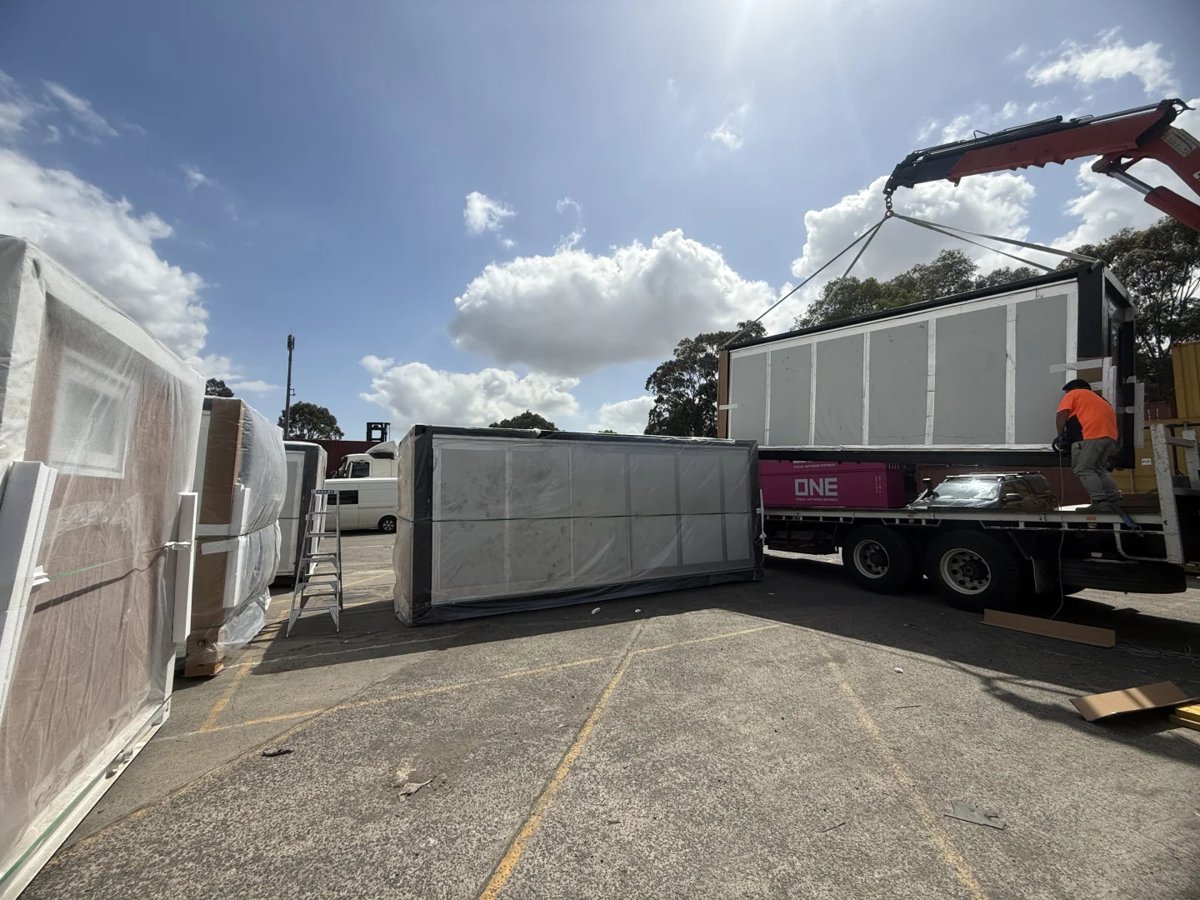
On the destination side, confirm who arranges inland transport, who pays port handling, and what unloading equipment waits at the site. Remote sites add a final leg that is easy to underestimate: road limits, seasonal closures and crane hire all belong in the budget before the units ship. Loading figures for the three formats are in our 40HQ loading guide. We do not quote freight in building prices; ask your forwarder for a route-specific rate.
Foundations are the line most often missing from a first budget. Ground conditions decide the base design — slabs, piers, or leveled hardstanding — and that design belongs to a local engineer who knows the soil, the drainage and the applicable codes. A building manufacturer can tell you the unit weight, the base footprint and the interface detail; the foundation itself is civil work.
Also budget for what surrounds the buildings: leveling, site drainage, access tracks for delivery vehicles and lifting equipment, and laydown space for staged deliveries. On remote sites these works routinely decide whether installation stays on schedule.
Installation effort depends on the product format. Flat pack units are assembled from components and bolted together; folding units unfold and lock in a short sequence; expandable units are craned into place and opened. Across all three, budget for crew, tools, lifting equipment, weather protection during works, and the connection detailing between adjacent units.
Check what your supplier actually offers here. Some quotations include installation guidance or site supervision; most include neither crew nor equipment. Clarify it in writing before comparing prices — an "installed" price and a "delivered" price are different contracts.
A complete camp runs on infrastructure the buildings only connect to: electrical distribution and possibly on-site generation, water supply and storage, wastewater collection and treatment, fire safety provision, roads, fencing and lighting. Who builds these works depends on the contract — the project owner, an EPC, or local specialist contractors under the engineering scope. They are not part of a building manufacturer's standard scope, but the building side must make the interface clean.
What the building side must do is make the interface clean: documented service entry points, drainage connections from kitchens, laundries and ablution blocks, and unit layouts that fit the site's utility plan. Planning inputs for these systems are in our guides to camp power supply and to the non-accommodation blocks of a workforce camp.
Send these items and every serious supplier can quote the same scope — which is the only way price comparisons mean anything:
Then ask for the quotation against the six cost blocks above, stating which blocks are included and which are excluded. A supplier who answers that question clearly is one you can compare. For price levels on the building side specifically, see how much a modular workforce camp costs; for product-level landed cost logic on folding units, see the folding container house landed-cost breakdown.
Normally not. Factory quotations are usually ex-works or FOB; ocean freight, port charges and inland haulage are separate. Always confirm the delivery term in the quotation before comparing prices.
As a rule, no. Foundations are civil works designed for local ground conditions. A manufacturer can supply unit weights and base interface data for your engineer; the foundation design and construction sit with local parties.
Location and port, headcount and room mix, building types beyond accommodation, site access conditions, utility scope and the delivery schedule. The list above is the full RFQ checklist we work from.
Yes — dormitories, offices, dining rooms and ablution blocks routinely ship together, and mixed product formats are normal. Combining them in one order simplifies freight planning and interface details.
Usually the buyer's crew or a local installer. Manufacturers can supply assembly documentation and, on some projects, guidance or supervision. Confirm exactly what is included — crew, equipment and supervision are separate lines from the building price.
Request a quotation against a clear scope
Send your project location, headcount and room mix, building list, site access conditions and delivery schedule. We reply with a quotation that states which of the six cost blocks are included and which are excluded — so the number you compare is the number you can budget.
Send your project details through the Wanbang enquiry form, and our project team will reply with a scoped quotation.


 IPv6 network supported
Hi! Click one of our members below to chat on
 English
 Français
 Deutsch
 Русский
 Italiano
 Español
 Português
 Türk
 Ελληνικά
 Indonesia
 عربي



