Capsule House Price: How Much Does It Cost 2026?
Apr 01, 2025
Ask five capsule house suppliers for a price and you will get five numbers that cannot be lined up against each other. One is quoting a bare steel skeleton, one is quoting a finished pod with the bathroom installed, another has included the air conditioners, and one has quietly left the sea freight and the crane out. This article does three things: it separates a capsule house price into the five delivery layers suppliers actually quote against, it lists what moves the number inside each layer, and it gives you a twelve-point alignment sheet so that two quotes you compare are finally quoting the same building.
Why A Price Per Square Metre Will Mislead You
Search results for capsule house cost are full of per-square-metre figures, and almost none of them state what the square metre contains. A rate quoted against an enclosed shell and a rate quoted against a factory-finished unit with a wet bathroom, kitchenette, split air conditioning and smart access can be compared arithmetically and still be meaningless, because one of them requires you to buy and install everything the other already includes.
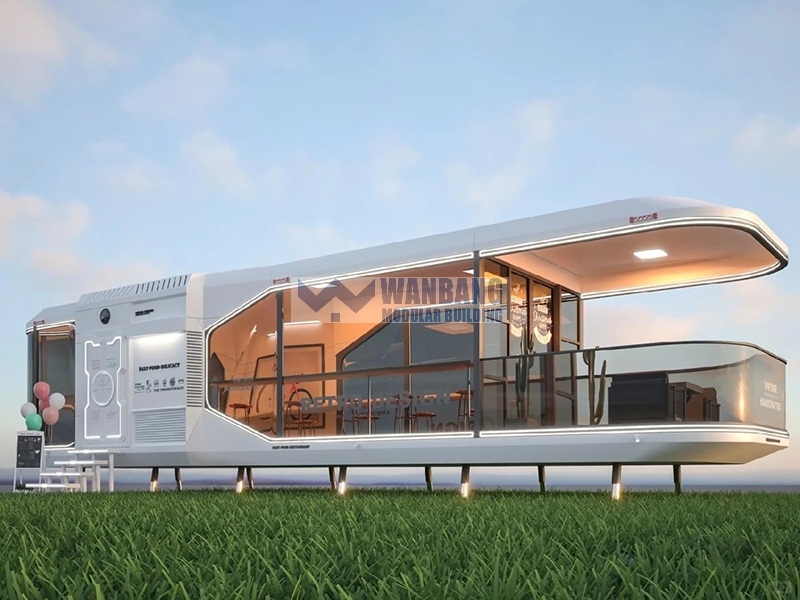
There is a second distortion. Capsule units are sold by footprint, but they are used by floor area. Our H11 model puts 72 square metres of finished living space on a 38 square metre footprint by stacking two levels. If you compare it to a single-storey 38 square metre pod on a price-per-footprint basis, the H11 looks expensive. On a price-per-usable-square-metre basis it is a different conversation, and on a price-per-bed or price-per-key basis it is a different conversation again. Decide which denominator your project is actually bought on before you read any quotation.
A third distortion comes from the site. Two buyers can order the same model and pay materially different totals because one is a twenty-minute flatbed run from a port and the other needs a low-loader up a mountain track, or because one has a concrete slab waiting and the other has to build a foundation before anything can be set down.
The Five Delivery Layers A Quote Can Refer To
Almost every capsule house price you receive is quoting one of these five layers. The table below is a map of what each one does and does not contain. The boundary descriptions are typical for the industry and for our own product range; your chosen model's technical specification sheet is the document that governs what is actually inside the box.
Layer
What is in it
What the buyer still has to buy
1. Structure
Galvanized steel frame, floor deck, primary and secondary beams
Panels, glazing, doors, everything else
2. Enclosed shell
Walls, roof, flooring, windows, external door, basic weather sealing
All services, all interior fit-out
3. Shell plus rough-in
Enclosed shell with conduit, plumbing rough-in, electrical boxes fitted but unterminated
Fixtures, sanitaryware, HVAC, commissioning
4. Factory-finished pod
Layer 3 plus bathroom, kitchenette, lighting, HVAC, smart access, tested at the factory
Transport, foundation, on-site hookup, local compliance
5. Installed and commissioned
Layer 4 plus delivery, setting on foundation, utility connection, commissioning, handover
Foundation design and build, permits, ongoing operation
These are typical configurations, not universal specifications. Two suppliers both claiming to quote layer 4 may still differ on whether the wet area is factory-sealed and water-tested, whether the air conditioning is a wall split or a concealed ducted unit, and whether lighting is a builder's batten or an integrated LED system.
The most expensive mistake is a layer mismatch
In practice, the largest cost error we see is not a supplier overcharging. It is a buyer choosing the cheaper quote without noticing it was quoting layer 2, then discovering during the build that the electrical, plumbing, bathroom and interior accounted for a substantial share of the difference. The cheaper quote was cheaper because it was a smaller scope. When you shortlist, write the layer number next to each price before you compare the numbers.
What Moves The Number Inside A Layer
Once two quotes are on the same layer, the remaining gap comes from specification. These are the variables that move a capsule house price most, in rough order of impact.
Size and form. A 28 square metre single pod, a 38 square metre pod and a two-storey 72 square metre unit are three different structural problems, not three sizes of the same thing. The two-storey H11 carries a reinforced concrete composite floor slab rated for 3.5 kN/m2 live load and a 150 x 100 x 3 mm Q345 primary frame, with a spiral stair or an optional lift connecting the levels. That load path does not exist in a single-storey unit, and it is the reason floor area does not scale linearly with cost.
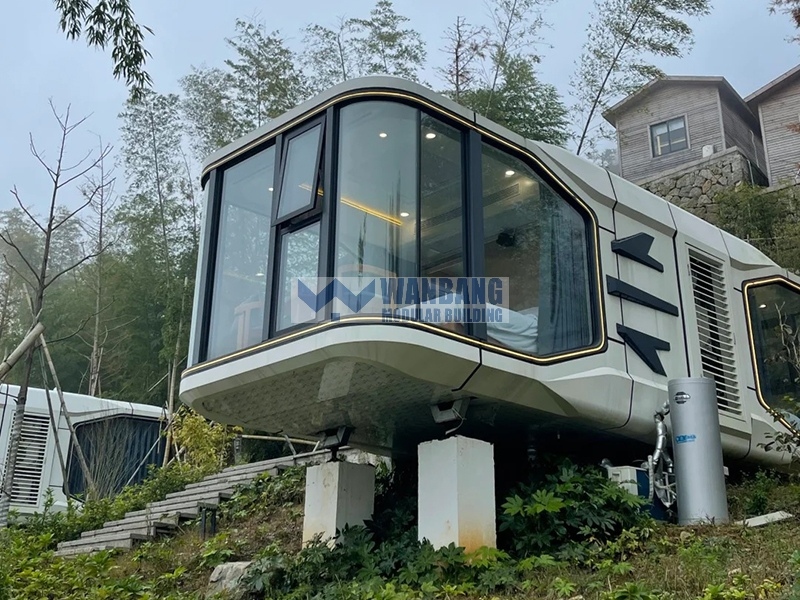
Frame and finish system. A hot-dip galvanized steel structure with a fluorocarbon-painted aluminium veneer exterior sits at a different level from a painted light-gauge frame with a flat panel skin. The difference is not cosmetic; it is the corrosion path that decides how the unit looks and performs in year five.
Insulation thickness and type. On the H11, the envelope uses 150 mm polyurethane injection across roughly 75 square metres of coverage, declared at a K-value of 0.022 W/mK. The compact 28 to 38 square metre range uses 100 mm SIPs panels. Same company, same category, two different thermal strategies with two different cost profiles.
Glazing area and performance. Glass is usually the most expensive surface per square metre on the whole unit. The H11 carries around 29 square metres of 6+12A+6 mm LOW-E glazing at a declared U-value of 1.2 W/m2K, plus a 5.7 m tempered glass balcony in the tourism configuration. Every square metre of glass you add does two things at once: it raises the purchase price, and it changes the heating and cooling load the HVAC has to handle.
Services and smart systems. A factory pod with dual-zone air conditioning, motion-sensing LED strips, a three-in-one smart lock, IP cameras and pre-installed conduit for rooftop solar is a different product from one with a light switch by the door. This is where capsule house quotes diverge most quietly, because the line items are small and easy to leave out of a comparison sheet.
Quantity and scheduling. Unit price is affected by batch size, because setup, jigging and material purchasing are spread across the run. It is also affected by when you want delivery. A slot in a normal production sequence costs less than a slot that requires the factory to displace other work.
The Landed Cost That A Factory Quote Does Not Show
A factory quote is an ex-works document. The total you will actually spend includes at least five further blocks, and on a small order these can rival the unit price itself.
Freight, driven by volume rather than weight. Capsule units are bulky and light. What you pay for is the space you occupy in a container or on a flat rack, which is why a foldable or knock-down format can change the economics of an order more than a discount on the unit itself. Ask for the packed volume per unit, not just the unit dimensions.
Port, clearance and inland movement. Destination terminal handling, customs brokerage, duties and any inland haulage to site are separate from the factory price and are frequently quoted separately by a forwarder. Ask your forwarder for a door-to-site figure at the same time you ask the factory for a quotation, so the two arrive together.
Foundation and lifting. A minimal foundation of graded gravel or concrete piers is enough for some compact models, but that is a statement about the unit, not about your ground. Soil bearing capacity, slope and drainage decide what is actually needed, and the lifting plan has to come from the engineering drawings rather than from a phone call.
Utility connection and commissioning. Water, power and drainage to the unit, plus the labour to connect and test, sit outside the factory scope unless you have bought layer 5. On a remote site, mobilising an electrician for a small number of units can be a surprising line on the budget.
Local compliance. Depending on where the unit is installed and how it is classified, you may need permits, structural sign-off, fire documentation or utility approvals. Cost and lead time here are set by the local authority, not by the factory, and should be confirmed before the order is placed rather than after the unit lands.
A Twelve-Point Alignment Sheet For Comparing Quotes
Send this list to every shortlisted supplier and ask them to answer it in writing alongside the price. Two quotes that both answer all twelve are comparable. Two quotes that answer eight are not.
#
Ask this
Why it changes the number
1
Which delivery layer is this price?
Sets the baseline scope
2
Footprint and finished floor area, both stated
Prevents a two-storey unit being compared on footprint
3
Frame steel grade, section and coating system
Drives durability and corrosion life
4
Insulation type, thickness and declared K-value
Drives HVAC sizing and running cost
5
Glazing build-up, area and U-value
Usually the largest single specification variable
6
Is the bathroom factory-assembled and water-tested?
Site-built wet areas cost more and fail more
7
HVAC type, capacity and brand
Often excluded from a "finished" quote
8
Packed volume per unit and shipping format
Sets the freight line
9
What is excluded, listed explicitly
The exclusions are where budgets break
10
Warranty terms by component
Structure and electronics rarely match
11
Lead time conditions: deposit, drawing approval, quantity
A lead time without conditions is not a commitment
12
Payment schedule and currency
Changes your cash position, not the price
What To Put In The First Inquiry
A factory can only quote accurately against a brief. Seven items turn a price request into a quotable enquiry: destination country and port, intended use, quantity, occupancy and layout requirement, site conditions including ground and access, services available at the site, and your target handover window. Send those seven and you will usually receive a specification-based price rather than a catalogue figure.
If you are still deciding on form, start from the size and layout options in our capsule house range, then look at the 28 to 38 square metre smart model as a worked example of what sits inside layer 4.
Questions We Get Asked About Capsule House Pricing
Is there a price per square metre I can use for budgeting?
No single rate is safe, because the same footprint can be quoted at layer 1 or layer 5 and the difference is not a rounding error. Use a rate only as a sanity check after you know the layer, the insulation and glazing specification, and what the freight and foundation will cost. A rate without those four attached is not a budget, it is a guess.
Why is a two-storey unit not simply double the price of a single-storey one?
Because stacking adds a floor structure, a vertical circulation element, a second envelope and additional services, while sharing one foundation and one roof. Some cost elements double and some do not. The fair comparison is cost per usable square metre, and even then you have to confirm both units are quoted at the same delivery layer.
What is most often left out of a factory quote?
Freight, destination charges, foundation, crane and rigging, utility connection, commissioning, and local permits. Some of these are legitimately outside a manufacturer's scope. The problem is not that they are excluded, it is that they are excluded silently. Ask for the exclusion list in writing.
Does order quantity reduce the unit price?
It can, because setup and procurement are spread across more units, but the size of the effect depends on the model and on how much of the build is standardised. It also cuts the other way on freight: a larger order may need a different shipping format. Ask for pricing at two or three quantities so you can see the curve rather than a single point on it.
Want a price you can actually compare?
Send your destination country and port, intended use, quantity, occupancy and layout, ground and access conditions, services available on site, and target handover window. We will return a specification-based quotation that states the delivery layer and the exclusions in writing. Submitting a brief does not commit you to an order, and it does not by itself confirm lead time, compliance in your jurisdiction, or suitability for your site.
Send your project brief
Related reading: How long do capsule houses last
{
"@context": "https://schema.org",
"@type": "BlogPosting",
"headline": "How Much Does a Capsule House Cost? A Practical Guide",
"description": "What determines the price of a capsule house: size, materials, features, customization and logistics, with a model comparison and buying guidance.",
"image": "https://www.gdwbprefabhouse.com/storage/uploads/images/202504/01/1743471947_U2zkmXmnI8.jpg",
"author": {
"@type": "Organization",
"name": "Guangdong Wanbang Modular Building Co., Ltd."
},
"publisher": {
"@type": "Organization",
"name": "Guangdong Wanbang Modular Building Co., Ltd."
},
"mainEntityOfPage": {
"@type": "WebPage",
"@id": "https://www.gdwbprefabhouse.com/"
}
}
Read More



 IPv6 network supported
 English
 Français
 Deutsch
 Русский
 Italiano
 Español
 Português
 Türk
 Ελληνικά
 Indonesia
 عربي



