Wanbang delivered 541 flat-pack container units to a mining site in Indonesia, used as site offices and worker dormitories. The camp sits in a climate that holds between 25 and 27 °C all year, with humidity of 70 to 90 percent, so every part of the specification had to answer to heat and moisture before it answered to anything else.

This was not a single-purpose camp. The order covered site offices and sleeping accommodation in one delivery, and those two functions pull the layout in opposite directions. Offices want to sit where the plant traffic, the gate and the power are; dormitories want to sit away from all three, because a shift that ends at two in the morning should not walk past the workshop to reach a bed.
Delivering both from one unit system keeps one set of connection details, one set of spares and one crew for the whole compound — and where labour has to be flown in, every extra trade is an extra flight.
The accommodation and sanitary units break down into four types. Dormitories are the bulk of it by a wide margin, which is what a workforce camp normally looks like:
| Unit type | Units |
|---|---|
| Dormitory units | 320 |
| Single rooms with a private bathroom | 51 |
| Toilet blocks | 12 |
| Shower blocks | 8 |
Two things about that mix matter. First, 51 rooms carry their own bathroom — the type usually held back for staff who do not share with a crew, and the difference between a camp that can host a client visit and one that cannot. Second, the wet areas are concentrated: 20 toilet and shower blocks carry the water supply, the drainage and the septic load that would otherwise be spread across 371 rooms.

At 70 to 90 percent relative humidity, what matters is not what matters in a cold climate. Condensation forms on the inside face of a panel when the panel is colder than the air, not when the air is wetter — so the question is where the dew point falls in the wall build-up, not how thick the insulation is. Our guidance on hot climates and remote camps sets out how that shifts by region.
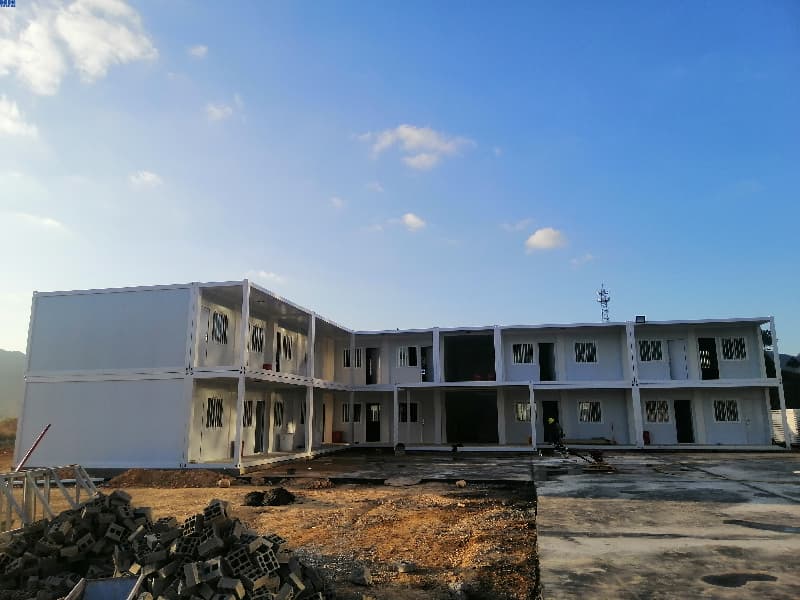
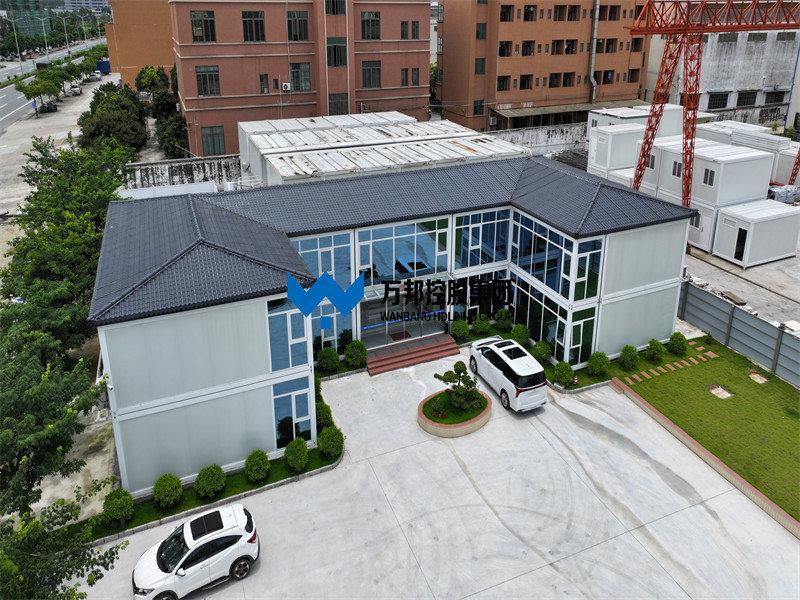
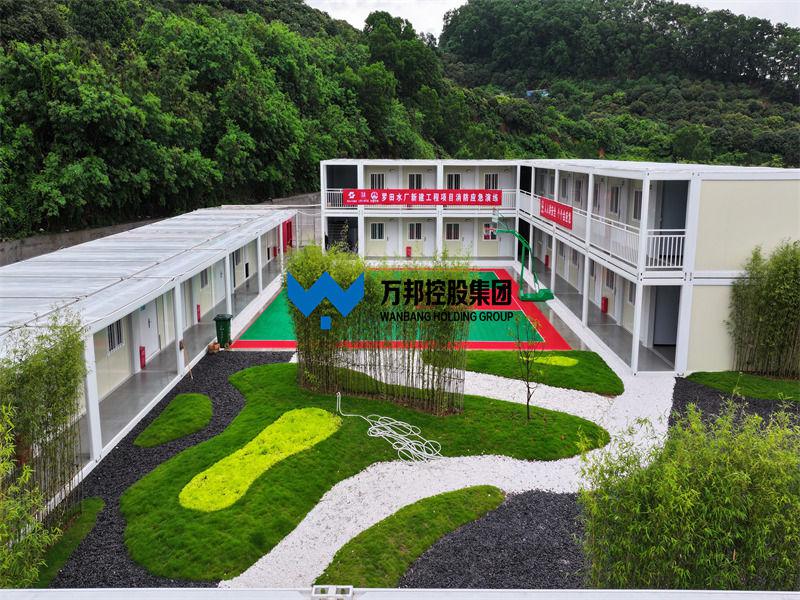
The other half of the answer is not in the wall at all. It is in the openings and the roof, and you can see both in the photograph below: a roof that projects past the wall line runs water clear of the facade instead of down it, and a grille on every window keeps the openings usable at night without letting the insects in.

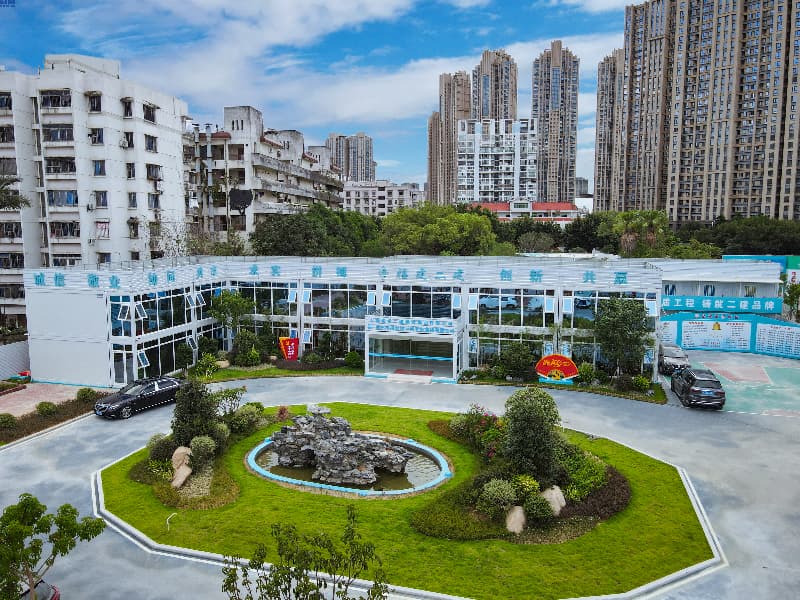
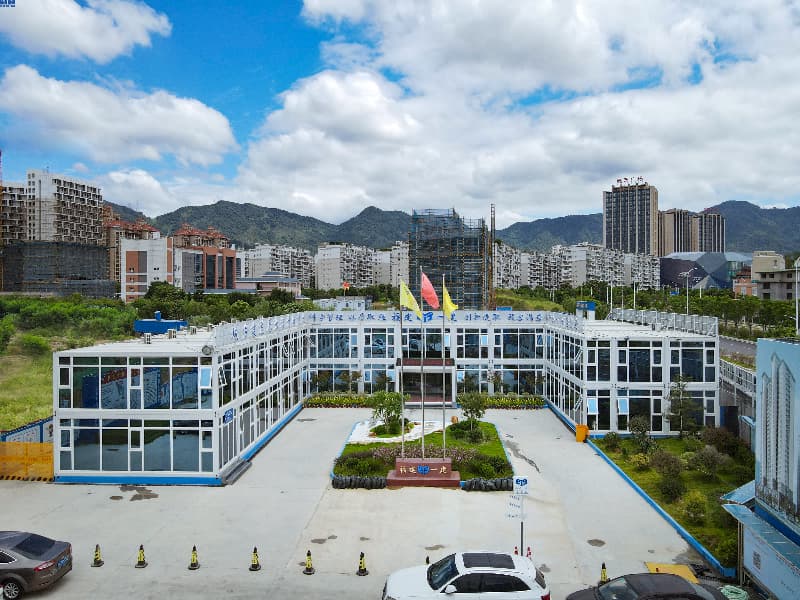
Stacking to two storeys is the other decision the photographs show. It halves the ground area for the same bed count, and on a site that has to be cleared, levelled and drained before anything arrives, the ground is the part you cannot ship. The trade-off is stairs and a shared walkway, which is a fire-planning question as much as a structural one — we cover it in two-storey modular dormitories.
Mining camps are rarely permanent. A pit moves, a haul road is re-cut, a contract is extended somewhere else, and the accommodation is expected to follow. Flat-pack units suit that pattern because they come apart at the fixings rather than being demolished, but "it can be moved" and "it can be moved three times" are different claims.
Two things decide which one you get: whether the lifting points are rated for a lift cycle rather than a single handling, and how much of the interior survives the trip. We cover the lifting points in the mining camp specification and procurement guide, the second move in which units survive a second and third move, and the sanitary package in the modular ablution block guide.
The same unit system has gone to a 360-unit steel plant camp in Lagos State and a 5,050 m² living compound for up to 1,000 personnel at Van. Between them they cover a coastal tropical site, a high-altitude cold site and this one, which is the useful comparison when your own site sits somewhere in between.
Planning a camp for a site you have not built on before?
Send us the bed count, the site plan and the climate data. We will come back with a unit mix, a block layout and a shipping split — and tell you which parts of it we cannot confirm without your ground survey. Talk to our team.


 IPv6 network supported
Hi! Click one of our members below to chat on
 English
 Français
 Deutsch
 Русский
 Italiano
 Español
 Português
 Türk
 Ελληνικά
 Indonesia
 عربي