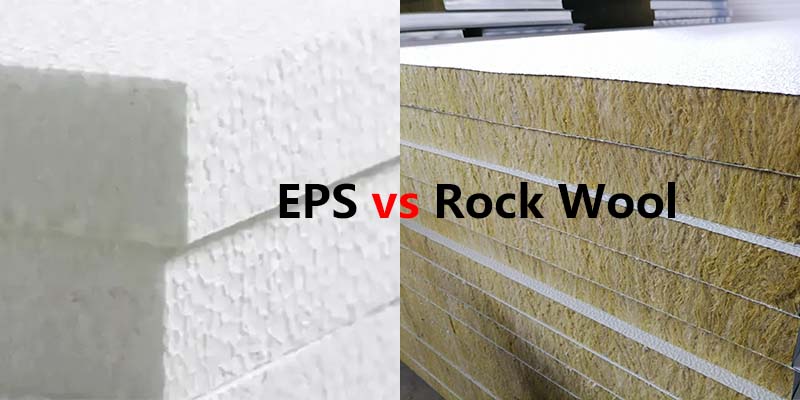
EPS vs. Rock Wool Insulation
Apr 08, 2025
EPS vs. Rock Wool Insulation
— In-Depth Comparison for Thermal Efficiency
1. Material Properties
EPS (Expanded Polystyrene)
Low Thermal Conductivity: EPS has a thermal conductivity of 0.033–0.038 W/(m·K), making it highly efficient for lightweight insulation. Its lightweight nature (15–30 kg/m³) suits modular designs like container homes or prefab buildings.
Moisture Sensitivity: Absorbs water easily, requiring waterproof coatings in humid climates (e.g., tropical regions).
Flammability: Requires fire retardants to meet safety standards, but melts under high heat, releasing toxic fumes.
Rock Wool
Fire Resistance: Made from molten basalt, it withstands temperatures over 1000°C, making it ideal for fire-prone areas such as camp kitchens, industrial sites or multi-storey buildings.
Sound Absorption: Fibrous structure reduces noise transfer, perfect for site offices, meeting rooms and staff areas.
Density & Weight: Heavier (60–200 kg/m³), increasing structural support needs but offering durability.
2. Safety & Health
Fire Safety
EPS requires chemical additives to achieve fire resistance (Class B1), but remains vulnerable to melting. Suitable for temporary structures like emergency shelters where fire risk is low.
Rock Wool is naturally fire-resistant (Class A1), used in steel construction or multi-storey modular buildings for enhanced safety.
Environmental Impact
EPS production involves petroleum-based chemicals, and recycling is challenging. Burning releases CO and black smoke.
Rock Wool is recyclable and made from abundant minerals, though its manufacturing consumes high energy (1400°C melting).
3. Cost & Longevity
Initial Cost
EPS is typically more affordable than rock wool, making it a cost-effective choice for budget-friendly projects like low-cost modular housing or temporary site offices.
Rock Wool’s higher cost is offset by its long service life and reduced insurance premiums in fire-prone zones.
Long-Term Savings
Rock Wool’s thermal stability lowers heating/cooling costs, especially in extreme climates (e.g., modular units in hot regions).
EPS may degrade faster in humid or high-heat environments, requiring earlier replacement.
4. Installation & Adaptability
Ease of Installation
EPS is lightweight and easy to cut, ideal for custom modular layouts where panels are trimmed on site.
Rock Wool requires protective gear (gloves, masks) due to fiber dust and often needs metal framing, increasing labor costs.
Structural Compatibility
EPS works well with lightweight foundations (e.g., container house foundations) due to minimal load.
Rock Wool suits heavy-duty structures like pre-engineered steel buildings or multi-storey modular projects.
5. Climate & Application Suitability
Humid / Tropical Regions
Rock Wool’s water resistance (<1% absorption) prevents mold, ideal for coastal projects and modular units in tropical regions.
EPS needs moisture barriers, limiting its use in flood-prone areas such as emergency housing.
High-Temperature Zones
Rock Wool excels in kitchens, industrial sites, or camp catering areas where fire safety is critical.
EPS is avoided in high-heat areas due to melting risks.
6. Design Flexibility
EPS: Easily molded into curves or custom shapes for modern prefab buildings or customized modular structures.
Rock Wool: Used in acoustic panels for office interiors, ceilings and meeting rooms.
7. Sustainability Trends
Green Certifications: Rock Wool is favored in eco-friendly projects due to recyclability.
EPS in Emerging Markets: Popular in cost-driven regions for budget-friendly housing.
Decision Guide
Budget & Short-Term Use → EPS (e.g., emergency shelters, construction offices).
Fire Safety & Durability → Rock Wool (e.g., multi-storey modular buildings, camp kitchens).
Humid / Noisy Environments → Rock Wool (e.g., coastal projects, office environments).
Lightweight & Creative Designs → EPS (e.g., lightweight structures, curved facades).
Need help choosing the right insulation for your modular project? Contact us and our engineers will help you select the insulation best suited to your climate, fire-safety requirements and budget.
{
"@context": "https://schema.org",
"@type": "BlogPosting",
"headline": "EPS vs. Rock Wool Insulation",
"description": "In-depth comparison of EPS and rock wool insulation for modular and container buildings, covering thermal efficiency, fire safety, cost, installation and climate suitability.",
"image": "https://www.gdwbprefabhouse.com/storage/uploads/images/202504/08/1744096479_NArAyBVGot.jpg",
"author": {
"@type": "Organization",
"name": "Guangdong Wanbang Modular Building Co., Ltd."
},
"publisher": {
"@type": "Organization",
"name": "Guangdong Wanbang Modular Building Co., Ltd."
},
"mainEntityOfPage": {
"@type": "WebPage",
"@id": "https://www.gdwbprefabhouse.com/"
}
}
Read More




 IPv6 network supported
 English
 Français
 Deutsch
 Русский
 Italiano
 Español
 Português
 Türk
Türk Ελληνικά
 Indonesia
 عربي
عربي


