EPS vs. Rock Wool Insulation
Apr 08, 2025
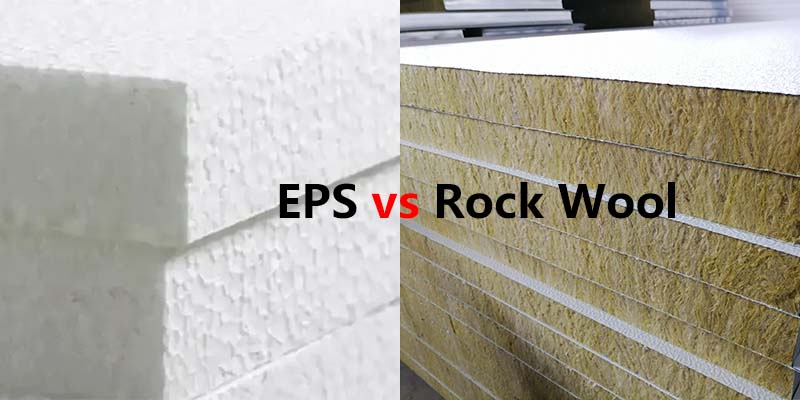
EPS and rock wool get compared as if you were choosing between insulation and fire safety. That framing is why so many buyers specify the wrong core. The two materials are close enough on thermal performance that the choice is rarely decided there. It is decided by moisture path, fire strategy, weight during handling, and the joining detail of the panel you are actually buying. This article corrects three claims that circulate widely and do not survive a standards check, then sets the choice against four real operating conditions, so you can specify a core for the failure mode your project will actually face.
Three Widely Repeated Claims Worth Checking
None of what follows is a criticism of either material. Both are legitimate, both are used in our own range, and both are the right answer somewhere. The problem is that the decision is often made on a comparison that has one fact backwards.
Claim 1: rock wool resists water and EPS absorbs it
On the material level this is the wrong way round. EPS is a closed-cell foam: the cells are sealed, so liquid water has very little path into the board, and that is why expanded polystyrene is used in buoyancy and in below-grade applications where it will be in contact with water. Mineral wool is an open, fibrous structure: water has a path in, and once in, it does not readily drain out again.
Where the confusion comes from is a real standard read incompletely. Under EN 1609, short-term water absorption by partial immersion is measured over 24 hours and expressed in kilograms per square metre of wetted surface. A value of no more than 1.0 kg/m2 is the common acceptance threshold for hydrophobic-grade mineral wool products. That is a 24-hour, partial-immersion, hydrophobic-treatment test result - not a statement that the material is waterproof, and not a statement about what happens over a monsoon season. Hydrophobic additives resist liquid uptake at the surface; they do not stop vapour from moving through a fibrous board, and they do not survive a defect in the weather barrier.
The practical consequence is the opposite of the myth. In a hot and humid climate, an EPS core is generally the more forgiving choice on moisture, because a closed cell has little capacity to hold water. A rock wool core needs a well-detailed vapour path and a sound external barrier. If that detail is wrong, the consequences are physical rather than theoretical: a wetted fibrous board conducts heat far better than a dry one, so the thermal performance you paid for quietly leaves the building.
Claim 2: EPS insulates better, rock wool is only about fire
The declared thermal conductivity ranges overlap. Typical declared values sit in the region of 0.031 to 0.040 W/(m.K) for EPS and roughly 0.034 to 0.045 W/(m.K) for mineral wool boards, both taken from the relevant European product standards and both dependent on grade and density. EPS is usually a little better per millimetre at the low end of that range. It is not a different category of performance.
What closes that gap in practice is thickness, not material. A 100 mm mineral wool panel and a 75 mm EPS panel can land in the same thermal territory, and the right answer for a cold store or a high-altitude site is almost always to increase thickness rather than to argue about the core. Our own H11 uses 150 mm polyurethane injection rather than either of these cores, because on that model the enclosure depth was available and the target was a declared K-value of 0.022 W/mK - a reminder that on a premium unit a third option often wins outright.
Claim 3: rock wool's weight means you need a heavier structure
Typical board densities run around 15 to 30 kg/m3 for EPS and broadly 40 to 200 kg/m3 for mineral wool, with construction boards usually in the middle of that band. On a small module the difference in total wall mass is measured in hundreds of kilograms against a building that already weighs tonnes. It does not redesign the foundation. What it does change is handling: heavier panels need more people or a lifting aid during assembly, and they cost more to move between factory and site. Decide on handling and transport, not on structural myth.
The Numbers Side By Side
The table below gives typical declared ranges for construction-grade boards. Every value varies by manufacturer, density and grade, and the supplier's declaration is the only figure that counts for your order.
Property
EPS
Rock wool
Structure
Closed cell, thermoplastic
Open fibre, inorganic
Thermal conductivity (declared)
approx. 0.031 - 0.040 W/(m.K)
approx. 0.034 - 0.045 W/(m.K)
Density
15 - 30 kg/m3
40 - 200 kg/m3 typical board
Reaction to fire (EN 13501-1)
Standard grade E; flame-retardant grades can reach B class
A1, non-combustible
Liquid water behaviour
Very low uptake, closed cell
Hydrophobic grades resist surface uptake; open structure holds water once wetted
Service temperature
Limited; softens well below flame temperatures
High; suitable for hot-service and fire-rated assemblies
Acoustic performance
Moderate
Good, fibrous structure absorbs sound
Handling during build
Light, easy to cut on site
Heavier, PPE required, more cutting waste
These are typical material properties, not system performance. A sandwich panel's fire rating and thermal performance are declared for the assembled product, not for the core alone, and that distinction is where most specification arguments go wrong.
Four Operating Conditions, Four Different Answers
Coastal or tropical resort units, high humidity and salt
The dominant risk here is not fire and not thermal conductivity. It is water finding its way into the envelope and staying there, with salt accelerating every fixing and every cut edge. EPS has the advantage on core moisture tolerance. Rock wool is defensible in this climate only if the vapour path is designed and the external barrier is genuinely continuous - and it is worth saying plainly that hydrophobic treatment is not a substitute for a weather barrier, because a fibrous board remains vapour-open by nature.
Whichever core you choose, in this climate the money is better spent on the joint detail, the flashing and the coating system than on a higher-performance core in a badly sealed panel.
Hot dry desert camps, large day-night swing
Moisture is not the enemy here; heat gain and thermal cycling are. Either core works, and the decision moves to thickness and to solar control on the glazing. Dust is the other factor: it loads HVAC coils and abrades door seals, so service access matters more than core type. Our own desert reference, a 150-unit camp for a power transmission project in the Atacama, sits in this category, and the specification conversation for those units is about heat load and maintainability rather than about which board is inside the wall.
Camp kitchens, generator rooms, hot work areas
This is where rock wool stops being a preference and becomes close to a requirement. A material that is A1 non-combustible and retains integrity at high temperature is the right choice wherever a cooking line, a fryer or a fuel store sits against the wall. EPS in these locations is not appropriate regardless of what flame-retardant grade the supplier offers, because a flame-retardant thermoplastic still melts and still contributes fuel.
Project camps that relocate every season
Weight and repairability dominate. A lighter panel is cheaper to move and easier to handle when a crew is dismantling in a hurry, and a panel that gets damaged in transit should be replaceable on its own. EPS wins on weight. Rock wool wins if the site also needs acoustic separation, but it loses if the panels will be repeatedly handled by people who are not specialists.
Thickness Matters More Than The Argument
The single most useful thing you can do with the core debate is move past it and set thickness against your climate. As a starting point rather than a rule: moderate climates with occasional extremes can often be served by around 50 mm; hot summers or cold winters usually justify 75 to 100 mm; and sites with sustained extremes in either direction, or where running cost is a design driver, generally need 100 to 150 mm. Our 28 to 38 square metre range uses 100 mm SIPs panels and declares an A1 reaction to fire with 42 dB sound reduction for that assembly, while the H11 goes to 150 mm polyurethane.
Thicker is not automatically better either. Wall thickness consumes internal floor area on a small footprint, adds weight, and shifts the dew point. The right process is to state your design temperatures, your internal setpoint and your acceptable running cost, and let the panel build-up follow from that - which is what an engineer does when you send them a site brief rather than a material name.
If you are at the stage of choosing a panel system for a specific building type, the flat pack container range shows how the same envelope logic plays out on a standardised module, and the prefabricated house range shows it on larger floor plates.
Questions We Get Asked About Panel Cores
Is rock wool safe to handle without protection?
No. Mineral wool generates airborne fibre and dust when cut, so gloves, eye protection and respiratory protection are normal practice on site. That is a handling requirement rather than a health verdict on the installed product, but it does add labour and supervision to any project where panels are cut on site rather than pre-cut at the factory.
Can I get a Class A fire rating with an EPS core?
Rarely, and not at the core level. Flame-retardant EPS can improve its reaction-to-fire classification, but a thermoplastic core remains combustible. Where a project's fire strategy depends on non-combustibility, mineral wool or a mineral-faced assembly is the route. Check the declared classification of the complete panel assembly, not of the foam.
Which core is cheaper?
EPS is generally the lower-cost core, and part of that advantage comes back to you as freight savings because the panels are lighter. Mineral wool carries a higher material cost, plus more handling time and more cutting waste. Whether the difference matters depends on the order size and on whether fire performance is a project requirement - and we will not quote a percentage difference here, because the gap moves with density, thickness and order volume.
Does the core alone determine whether the unit passes a fire inspection?
No. Fire performance is assessed on the assembly and against the rules of the jurisdiction where the unit is installed. The core is one input. Detailing at penetrations, the fire strategy for the whole building, escape routes and the local code all enter the decision, and none of those can be confirmed by a supplier from a material datasheet.
Need the core chosen against your climate, not a catalogue?
Send the installation country and site conditions, the intended use including any cooking or hot-work area, the number of units, your design temperatures and your fire requirements. We will propose a panel build-up with a declared thermal and reaction-to-fire classification for the assembly, and state what still has to be confirmed locally. An enquiry does not commit you to an order, and no manufacturer can certify your building against a code we do not administer.
Send your specification brief
Related reading: How long do capsule houses last
Read More



 IPv6 network supported
 English
 Français
 Deutsch
 Русский
 Italiano
 Español
 Português
 Türk
 Ελληνικά
 Indonesia
 عربي



