OEM in modular buildings does not mean the buyer can change anything. It means the buyer can change the things that do not touch the structure, and must leave alone the things that do. Most failed OEM orders fail on that boundary rather than on price: the layout was customised, the branding was applied, and then the frame or the lifting points were changed too, and the unit that arrives is no longer the unit that was approved.
This page sets out where the line sits, in the order an order actually moves: what can be changed, what should not, how the sequence runs from drawing to shipment, and what to put in the first message so the quotation is built against a specification instead of a picture.
The word is used for three quite different arrangements, and the difference decides how long the order takes and who owns which drawing.
Most B2B enquiries that arrive described as OEM are the second type. They are also the type with the clearest cost and the shortest schedule, because the structural engineering has already been done and the changes sit in the fit-out layer.
Within the structural grid of a standard unit, these five areas are normally open. Each one is captured in the drawing package and confirmed in writing before production starts.
Three items sit outside the normal customisation scope. Changing any of them converts a supply order into an engineering project, and the quotation, the schedule and the certification all move with it.
The structural frame. Section sizes, the folding mechanism on an expandable unit and the connection details between units are calculated, not selected. A request to make the frame lighter, or to remove a member to gain headroom, changes the load path and invalidates the calculations the unit was built against.
The fire and insulation specification. Panel core, thickness and the fire performance claimed for the assembly belong to the tested build. Substituting a core to hit a price changes the fire behaviour and, in most markets, the approval route as well. If a local code requires a particular performance, state the requirement at enquiry stage so the build is specified against it rather than modified towards it.
The lifting points and the lifting plan. Lifting points are marked on the unit and specified in the drawing package for a reason: they are where the frame was designed to take the load. Moving them, or lifting from a point that looks convenient on site, is how units arrive distorted. The lift itself is site scope, and the lift plan belongs to whoever owns the crane.
| Stage | What the buyer provides | What comes back |
|---|---|---|
| Brief | Use, headcount or room count, site location, access, voltage, destination | Model recommendation and indicative scope |
| Layout drawing | Marked-up layout, or the requirement in words and dimensions | Layout drawing for approval, with the structural grid shown |
| Specification freeze | Signed approval of layout, finishes, electrical standard and documents | Final specification, quotation and production slot |
| Production | Any change request, in writing, before the stage gate | Progress photographs and the inspection arrangement |
| Pre-shipment | Inspection attendance or a nominated third party | Packing list, drawings as built, certificates and shipping documents |
The stage that decides the outcome is the specification freeze. Once it is signed, every later change moves the production slot, and on a camp order with dozens of units a late change is expensive in a way that the same change on a single unit is not. The practical rule is to freeze the layout before the deposit and accept that cosmetic changes after that point cost time rather than money.
Six items separate a quotation that can be compared from one that has to be renegotiated. They take ten minutes to assemble and save weeks later.
Where the order is a series, say so early. A first unit and a run of forty are quoted differently, and the packing plan for a series is worth designing once rather than per shipment.
OEM buyers often assume the cost is in the branding. It rarely is. The cost sits in four places, in roughly this order: the number of wet areas, because each one carries plumbing, waterproofing and ventilation; the electrical standard, because it changes the distribution and the fittings; the opening schedule, because every non-standard window or door is a separate item; and the packing plan, because it decides how many units fit into a container and therefore what the freight costs per unit.
Branding and documentation sit at the bottom of that list. They matter for the buyer's market position and barely move the unit price. A buyer who wants a lower number is usually better served by simplifying the layout than by negotiating the nameplate.
Standard models start from a single set, and custom runs are quoted against the confirmed specification. We do not publish a price table for OEM work, because the number depends on the four variables above and a published figure would be wrong for almost every enquiry.
An OEM buyer is usually the party responsible for the documents their own client sees, so the document set has to be agreed at the freeze rather than collected at the port. Confirm which drawings are issued as approved-for-construction and which as-built, which test reports travel with the unit, and in which language the manual and the labels are printed.
On certification, keep two categories apart. ISO 9001, ISO 14001 and ISO 45001 are management system certifications, describing how the manufacturer is organised. EU CE is a conformity marking that applies to the products and specifications named in its declaration. Holding the management certificates does not establish that a particular model carries CE marking for your destination, so ask for the declaration that covers the model and the standard you are buying against, and check it against your own approval route rather than treating it as a substitute.
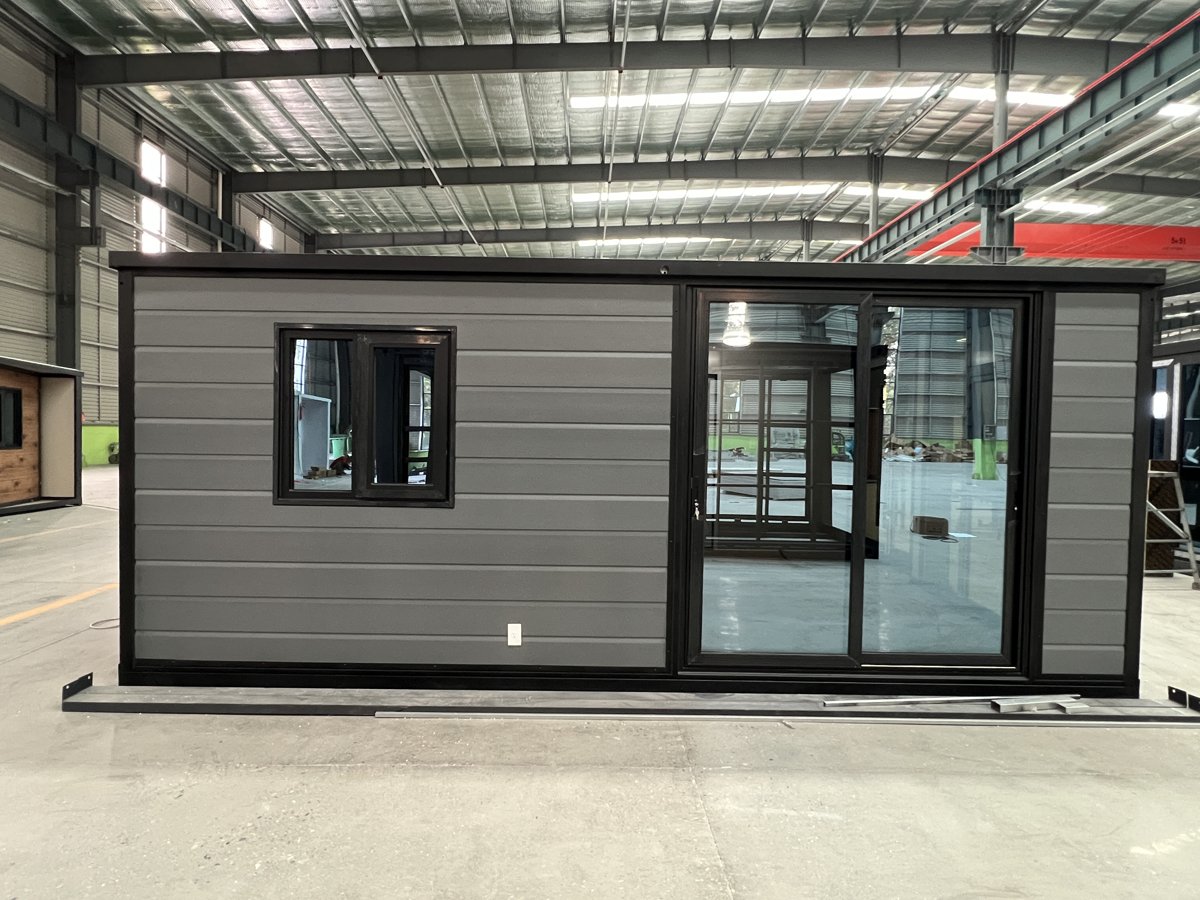
The factory side of an OEM order is repeatable: drawings, approval, production, inspection, packing. The part that varies is how well the buyer's requirements were written down before production started. A supplier who asks for the six items above is easier to work with than one who quotes from a photograph, because the quotation has something to be held to.
If the order is the buyer's first from China, it is worth reading how to verify an ISO 9001 certified supplier before the factory visit, and comparing the expandable range with the modular house range to see which platform the customisation should start from.
Standard models start from a single set, which is the published minimum for the 20ft expandable unit. Custom work is quoted per project: a changed layout on an existing platform can run from one unit, while a new configuration or a new product line needs tooling and a prototype and is scheduled as a development project. The minimum is therefore a function of the change, not of the model.
Yes. Nameplate, manual, packing marks and label language are agreed at the specification freeze. What cannot be branded away is the origin of manufacture where the destination market requires it to be declared, and that requirement belongs to your import route rather than to the factory.
The production time for a customised standard platform is close to the standard model once the drawings are approved. What adds time is the approval loop before production: layout revisions, finish samples and the electrical review. New configurations take longer because they include design and prototyping. We quote lead time against the confirmed specification rather than publishing one figure for every order.
Finishes, fittings and sometimes partitions can be adjusted, but the structural frame, the panel core and the lifting points cannot. Modifying a finished unit on site usually costs more than building it correctly, and it can void the basis on which the unit was supplied. If the requirement is known, put it in the order.
The buyer, or the local party holding the permit. The factory supplies the specification, drawings and test documentation that the approval process asks for, but it cannot obtain consent in a jurisdiction where it is not the applicant. Confirm the approval route before the specification freeze, because it sometimes changes the panel or fire requirement.
Start the OEM order from a written brief
Send the use, the layout sketch, the destination, the voltage and the quantity. We will come back with the platform that fits, the changes that are open on it, and the drawing you need to approve before production.
Contact our project team with the brief, or start from the 20ft expandable platform and tell us what has to change.


 IPv6 network supported
Hi! Click one of our members below to chat on
 English
 Français
 Deutsch
 Русский
 Italiano
 Español
 Português
 Türk
 Ελληνικά
 Indonesia
 عربي